
How do you check the tread on a tyre?
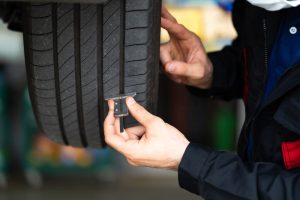
The tyre tread is essential for safe driving – it is responsible for braking distance, rainwater drainage and also for vehicle control. It is therefore worth checking the tread depth from time to time – how should you do this and, above all, when should you replace your tyres with new ones?
Are you wondering what the correct tread depth is for tyres? The law states that it must not be less than 1.6 mm, but in reality, a reading below 3 mm should be reason enough to replace your tyres with new ones. Why, and how, should you check your tyre tread depth yourself?
Tyre tread and road safety
The grooves in a tyre – in other words, the tread – are responsible for the tyres’ grip on the road surface. This is particularly important in so-called difficult road conditions, such as in the rain or on icy roads. Worn tyre treads can lead to a loss of control over the vehicle, which is particularly noticeable on bends, and also significantly increases the braking distance even at the optimum speed of 50 km/h.
Although the Act stipulates that the tread depth of a tyre should not be less than 1.6 mm, Tyres should be changed when the tread depth reaches just 3 or 4 mm. Why is there this slight difference? The 3 mm applies to summer tyres, whilst the 4 mm applies to winter tyres, which lose grip much more quickly in difficult conditions.
How quickly does the tread on a tyre wear out?
New tyres They usually have a tread depth of 8–9 mm, so they should easily last for around 60,000 kilometres. However, Tyre tread life also depends on driving style drivers, as well as road conditions.
Drivers who brake more frequently and more sharply can wear down their tyre tread much more quickly. The same applies to drivers who enjoy driving on rough terrain – particularly off-road, where tyres are exposed to completely different types of impact.
How do you check the tread depth on a tyre?
Many manufacturers include markings on tyres – such as the numbers 7-6-5-4-3 and so on – which indicate the current tread depth. If the number 7 is no longer visible, this means that the tread depth is 6 mm, whilst if the number 4 is no longer visible, the tread depth is approximately 3 mm and the tyre needs replacing.
It is worth bearing in mind that such markings are not mandatory (only the statutory 1.6 mm marking is mandatory), and therefore not every manufacturer is required to comply with them; for this reason, it is good to know that, how to check tyre tread depth yourself.
The simplest way is using a coin for this purpose, or to be precise, a two-złoty coin – if the tread is wider than its diameter, it means we can still drive on the same tyres; if it is the same width or narrower, it’s worth replacing them with new ones. The second method is to place a rolled-up piece of paper or a stick against the tyre and then measure it with a ruler.
It’s also worth use tread gauges, which are available at petrol stations or whilst you’re out and about tyre change at the tyre repairer’s. Remember that when measuring the tread depth, you need to take measurements at several points, as tyres do not wear evenly.