
What are run-flat tyres?
As a team with many years’ experience in the industry, we are asked about this technology on a daily basis. Drivers encountering it for the first time are often surprised at just how much it changes the game when it comes to a ‘flat tyre’. I remember a customer from Mokotów who came to us with a punctured Run-Flat tyre and was hugely impressed that his BMW handled almost as normal, allowing him to safely leave the busy road and reach our garage in Włochy. That’s why we’ve decided to draw on all our knowledge and experience to explain, in simple terms, what you need to know about these exceptional tyres.
In a nutshell
- If you have a puncture in a run-flat tyre, you can continue driving for up to 80 km at a speed not exceeding 80 km/h.
- The special, reinforced design of the sidewalls supports the vehicle’s weight even when the tyre is deflated.
- To use run-flat tyres, your car must be fitted with a fully functional tyre pressure monitoring system (TPMS).
- Replacing and fitting tyres of this type are more expensive and require specialist equipment and expertise.
How do run-flat tyres work after a puncture?
The secret behind how Run-Flat tyres work lies in their unique, self-supporting construction. Unlike a standard tyre, which immediately ‘flattens’ and buckles under the weight of the car when it loses pressure, a Run-Flat tyre retains its shape. This prevents the rim from damaging the tyre from the inside, whilst allowing you to maintain control of the vehicle. You can safely slow down and carry on driving, rather than stopping in a potentially dangerous spot. In our experience, this solution significantly improves road safety by eliminating the risk of a sudden blow-out and loss of control.
What does it mean when a tyre has a reinforced construction?
The reinforced construction is key to the functioning of Run-Flat technology. The sidewalls of such a tyre contain a special, very hard and heat-resistant rubber compound, which is considerably thicker than in traditional tyres. It is these rigid sidewalls that bear the entire weight of the car when the tyre loses air. In addition, the tyre bead – the part that contacts the rim – has a special profile that prevents the tyre from slipping off the rim whilst driving with deflated tyres. When we remove such tyres at our service centre, the difference in stiffness and weight is immediately noticeable compared to standard models.
How can you tell if tyres are run-flat tyres?
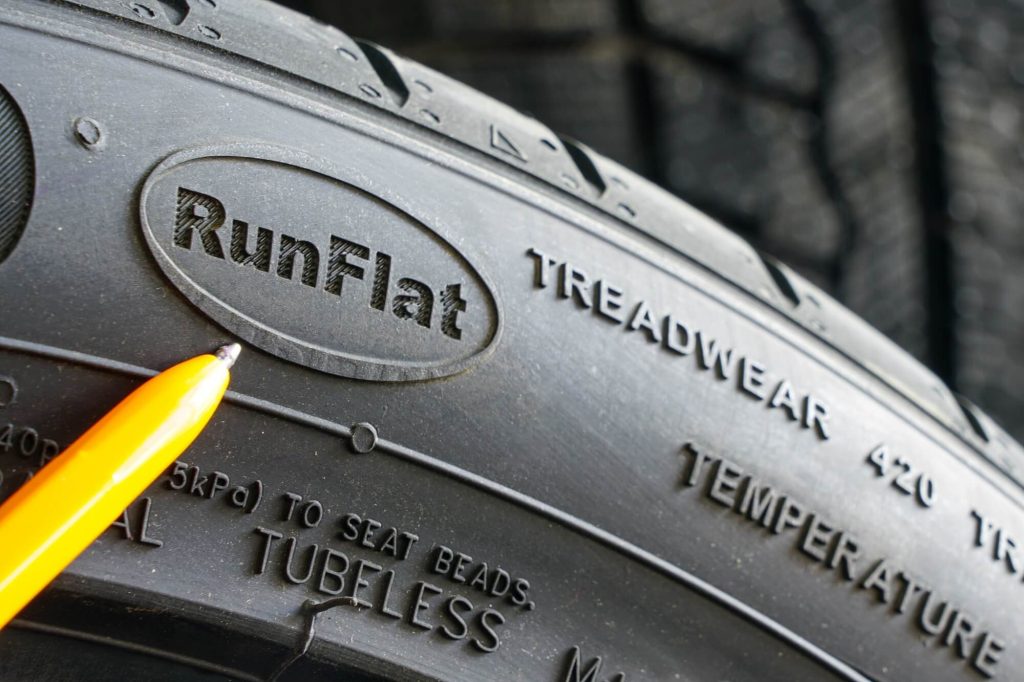
The simplest way to identify a run-flat tyre is to look for the relevant marking on its sidewall. Manufacturers use various symbols to indicate that a particular model has been manufactured using this technology. It’s worth bearing this in mind, particularly when buying second-hand tyres or if you’re unsure what type of tyres are fitted to your car. The absence of these markings almost certainly means you’re dealing with a standard tyre.
What are the manufacturers’ markings for run-flat tyres?
Each of the leading tyre manufacturers has its own naming system for Run-Flat technology. Although the concept is the same, the symbols can be confusing, which is why we’ve put together a handy guide. Knowing these abbreviations comes in handy when visiting a service centre or choosing tyres yourself. Here at Wulkanizacja 24H, we always check these markings to ensure we select the correct service procedure.
| Manufacturer | Run-Flat marking |
|---|---|
| Michelin | ZP (Zero Pressure) |
| Goodyear | EMT (Extended Mobility Technology) or ROF (Run On Flat) |
| Bridgestone | RFT (Run-Flat Tyre) |
| Continental | SSR (Self-Supporting Runflat) |
| Dunlop | DSST (Dunlop Self-Supporting Technology) |
| Pirelli | Run-Flat |
| Nokian Tyres | Flat Run |
| Yokohama | ZPS (Zero Pressure System) |
Do I need a TPMS system for run-flat tyres?
Yes, having a properly functioning tyre pressure monitoring system (TPMS) is absolutely essential. Run-flat tyres are so stiff that, even with a slight or even complete loss of pressure, the driver may not notice it. Without a warning from the TPMS, you could unwittingly continue driving at excessive speeds, which would lead to irreversible tyre damage and create a dangerous situation. At our service centre in Warsaw, we offer a full range of TPMS services, from diagnostics to calibration and sensor replacement, which is a key element in the safe use of run-flat tyres.
How far can you drive on a run-flat tyre without air?
Manufacturers of run-flat tyres usually specify the maximum distance that can be travelled after a puncture as approximately 80 kilometres. However, this figure should be regarded as a guide and for emergency use only. The aim is not to carry on driving as if nothing had happened, but to reach the nearest tyre repair shop safely. Driving for longer, especially with a heavier load, can lead to overheating and permanent damage to the tyre’s internal structure, which will ultimately make it impossible to repair.
What is the speed limit when you have a flat tyre?
The maximum permitted speed when driving on a deflated run-flat tyre is usually 80 km/h. Exceeding this limit is extremely dangerous. Higher speeds cause the temperature inside the tyre to rise rapidly, which can lead to delamination – that is, the tyre splitting and becoming damaged. Please also bear in mind that even at lower speeds, the car’s handling is compromised – particularly when cornering and braking. We always advise our customers to drive with great caution and avoid sudden manoeuvres.
What should you do if you get a flat tyre in Warsaw?
If you get a flat tyre in Warsaw – even if you have run-flat tyres – the best course of action is to call for help as soon as possible. Instead of trying to find a garage on your own, and risking further damage, you can use our service. Our mobile tyre repair service travels to customers throughout Warsaw and the surrounding area, from Bemowo to Ursus. Whether you’re in a car park outside your office in Wola or on the side of the road in Ochota, our team will arrive with the right equipment and deal with the problem professionally, saving you time and stress.

What are the main advantages and disadvantages of run-flat tyres?
Choosing run-flat tyres is always a trade-off. On the one hand, you gain a great sense of peace of mind and safety; on the other, you have to accept certain inconveniences and higher costs. In our day-to-day work, we strive to present both sides of the coin to our customers honestly, so that they can make an informed decision. The final choice depends on your priorities, driving style and car model.
Advantages: safety and more boot space
The main and undeniable advantage is safety. A run-flat tyre protects against a sudden loss of control of the vehicle in the event of a puncture, which can save lives on a motorway. The second benefit is convenience – you don’t have to worry about changing a tyre in the rain or on a busy road. Car manufacturers also capitalise on the fact that a car fitted with Run-Flat tyres does not require a spare wheel or a repair kit. This translates into more boot space or a lighter vehicle.
Disadvantages: price, comfort and faster wear and tear
Unfortunately, the list of drawbacks is also significant. Run-flat tyres are considerably more expensive to buy than their standard equivalents. Their rigid construction, whilst safe, has a negative impact on ride comfort – the car feels stiffer and does not absorb bumps as well. Many drivers also complain about higher noise levels. In our experience, these tyres can also wear out slightly faster, and fitting and removing them is more complicated and expensive.
Can run-flat tyres be repaired?
The reparability of run-flat tyres is one of the most controversial topics in our industry. Most tyre manufacturers officially do not recommend repairing them, citing safety concerns. After driving with a deflated tyre, the internal structure of the tyre may have sustained micro-damage that is invisible to the naked eye but weakens its structure. At our service centre, we approach this issue with great caution, putting customer safety first.
When is a repair possible, and when is a replacement necessary?
As a general rule, we advise against repairing a run-flat tyre that has been driven for any distance whilst deflated. The risk is simply too great. We may allow a repair under certain conditions, where the damage was minor (e.g. a nail in the tread) and the driver stopped immediately upon receiving a TPMS alert and did not continue driving. We assess each such case individually, but in 9 out of 10 situations, based on our extensive experience in the tyre industry, we recommend replacing the tyre with a new one. This is the only solution that offers a 100% guarantee of safety.
How much does it cost to replace Run-Flat tyres?
The Run-Flat tyre replacement service is more expensive than for standard tyres. This is directly due to their design and the equipment requirements. The fitting and removal process is more time-consuming and requires greater strength, precision and experience from the technician. The higher price of the service therefore reflects both the greater amount of work involved and the need to invest in advanced machinery capable of handling this type of tyre without risking damage.
Why is fitting run-flat tyres more expensive?
Fitting Run-Flat tyres requires the use of specialised tyre changers with additional support arms. The extremely rigid sidewalls offer considerable resistance when mounting and demounting the tyre from the rim. Attempting to fit them using standard equipment usually results in damage to the tyre bead or scratches, or even warping, of the expensive alloy wheel. That is why, at our workshop, we invest in modern equipment that guarantees a safe and professional tyre change Run Flat, and afterwards we carry out precise wheel balancing with a road test to ensure perfect handling.
Where in Warsaw can I get Run-Flat tyres replaced professionally?
Choosing the right service centre for Run-Flat tyres is crucial for your safety and your wallet. Not every garage has the right equipment and expertise to do the job properly. If you’re looking for a trusted service centre in Warsaw that specialises in this type of tyre, please come and see us. Our team has many years’ experience and the necessary qualifications to guarantee the highest quality of service.
Why should you choose our service in Włochy?
Our service centre in the Włochy district of Warsaw is a place where we combine a passion for motoring with professionalism. We have certified tyre changers designed to handle low-profile and run-flat tyres. After every tyre change, it is standard practice for us to wheel balancing with a road test, which simulates road conditions and eliminates vibrations completely. This ensures that your car will handle comfortably and safely, whatever your speed.
We are open 24 hours a day, 7 days a week
One of our greatest strengths, which our customers appreciate, is our availability. As Wulkanizacja 24h, we are at your service 24 hours a day, seven days a week, including all Sundays and public holidays. A flat tyre never happens at a convenient time, which is why you can count on us at any time of the day or night. Whether you need urgent assistance in the middle of the night or wish to book a tyre change at a time that suits you, our team is ready to help.
Summary
- Run-flat tyres are a technology that enhances safety and convenience, allowing you to continue driving for up to 80 km at speeds of up to 80 km/h after a puncture.
- Using them requires a fully functional TPMS system and entails higher purchase and maintenance costs compared to standard tyres.
- In most cases, manufacturers and professional garages do not recommend repairing run-flat tyres due to the risk of hidden structural damage.
- Choosing a service centre with the right equipment and experience – such as our Wulkanizacja 24h in Warsaw – is crucial for the safe and proper handling of this type of tyre.