
How can you tell if your tyres are worn out?
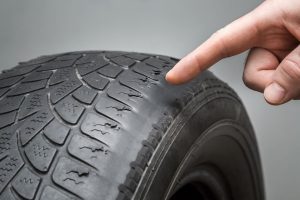 A natural consequence of using a car is that its tyres wear out. Regardless of the road surface you drive on and your driving style, you must expect that, after a certain amount of time, tyres will need replacing. How can you tell when the time has come? Here are the signs of worn tyres that suggest you need to visit a tyre repair shop.
Tyre Wear Indicator (TWI)
To standardise the method of checking and indicating the degree of tyre wear, the TWI indicator was introduced. When do we say a tyre is worn? When the tread depth is less than the minimum permitted depth of 1.6 mm. In such a situation, grip automatically deteriorates, particularly on wet surfaces. Driving on ‘bald’ tyres is not only dangerous but also illegal. You could be fined if you’re stopped for a roadside check!
In practice, it is quite easy to see and feel when tyres are worn out and need replacing. Tyres with a worn (shallow) tread, as well as those that are brittle or mechanically damaged, are not suitable for further use.
Not sure if it’s time to change your tyres yet? Consult a reputable tyre specialist, who will assess the condition of your tyres both inside and out.
Worn tyres – causes
There are many reasons why tyres wear out. Of course, this is usually the result of normal vehicle use, but that is not the only factor. We can identify several types of tread wear on tyres:
- circular – this is shoulder wear, characterised by a higher tread depth in the centre of the tyre,
- centre – concave wear is characterised by faster wear of the central part of the tread, which occurs when tyre pressure is consistently too high,
- asymmetrical – tyre wear caused by incorrect wheel alignment – one tyre wears out faster than the other,
- toothed edge – abrasion resulting in the formation of characteristic steps.
Tyre wear is caused by different driving styles and vehicle settings. Identifying any irregularities is important, as this may affect planned repairs or maintenance of components. It is worth consulting an experienced tyre specialist on this matter.
Worn tyres – signs
Do you feel that your car has poorer grip on the road? This should set alarm bells ringing. Don’t ignore other signs of worn or damaged tyres either. These include:
- cracks, scuffs,
- stains and chafing,
- worn-out rubber,
- delamination of the tread,
- a bent wire,
- a break in the warp threads.
Have you noticed the changes mentioned above, or any others that require consultation with an expert? Please do not hesitate to visit a professional service centre.
Please note! Tyres have, so to speak, an expiry date – that is, a period during which they can be used safely. This is usually calculated from the date of manufacture – after a maximum of 10 years, even if the tyres show no signs of wear (which is unlikely) or damage, they must be disposed of.
You must not drive on worn tyres. If you notice any type of wear – localised, overall, asymmetrical or central – contact your tyre dealer.