
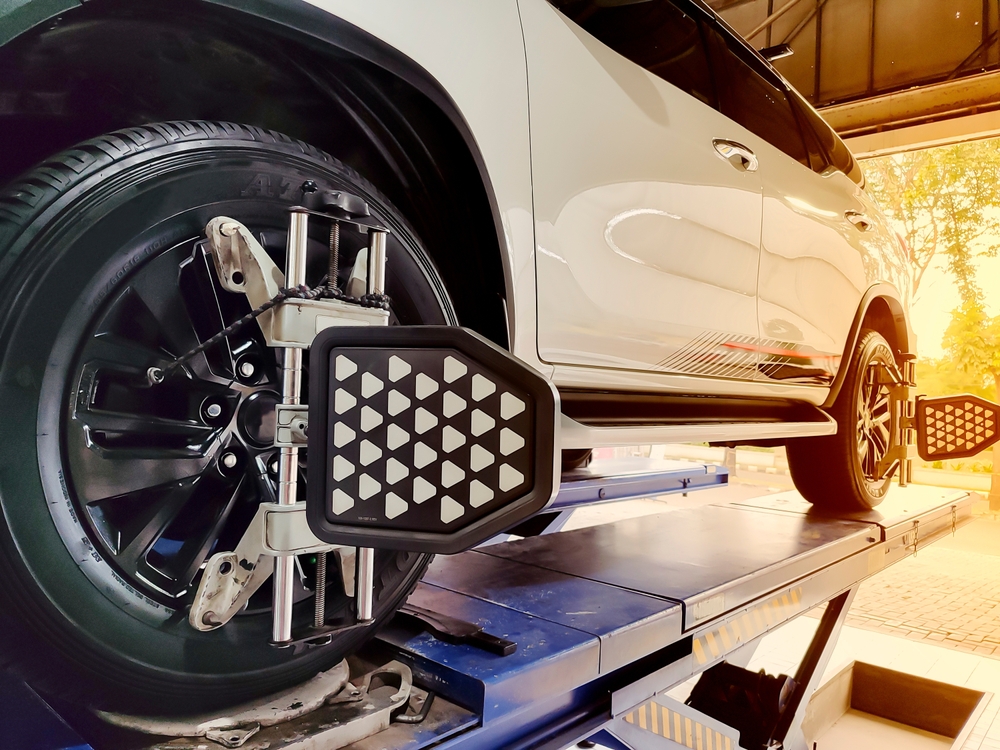
Correct wheel alignment ensures safe and controlled driving. It refers to the relative positioning of the wheels on each axle. Misalignment most commonly occurs as a result of driving over bumpy, uneven surfaces. If the vehicle starts to pull to one side, or if other noticeable abnormalities occur whilst driving, these may indicate that the wheel alignment is out of order. In this article, we focus on the symptoms of this issue and offer advice on how to deal with wheel alignment.
Symptoms of poor wheel alignment
Incorrect wheel alignment will not go unnoticed. Ride comfort is significantly reduced when the axles are out of alignment, and every driver should notice the difference. Often, the car is unable to maintain a straight course, even if the driver is not turning the steering wheel and the road surface is completely level. Uneven tyre wear also occurs on individual tyres.
The second important symptom is increased fuel consumption. This is, of course, due to the increased rolling resistance caused by incorrect wheel alignment. To overcome this resistance, the vehicle must use more energy. Consequently, driving with incorrectly aligned wheels is uneconomical and puts a strain on your wallet.
Drivers who also value comfort whilst in the vehicle’s cabin will also experience bothersome symptoms. Incorrect wheel alignment causes excessive, easily audible noise. This is due, amongst other things, to excessive and uneven tyre wear.
Another important indicator is the position of the steering wheel when driving in a straight line. If it is misaligned but the vehicle is still travelling in a straight line, this is most likely due to incorrect wheel alignment. Furthermore, the steering wheel may shake and vibrate when driving at higher speeds.
Nor can we overlook a symptom that is crucial to the car’s handling – namely, the vehicle’s reduced manoeuvrability and its generally diminished stability. The car may respond unusually, with a delay, or imprecisely to the driver’s actions. This is particularly noticeable when entering bends.
Symptoms of poor wheel alignment – how to deal with them?
A qualified mechanic should be able to sort out the wheel alignment mechanic car-related. At our company, we provide assistance to all drivers in need, by carrying out wheel alignment in Warsaw. It is not worth putting this task off until later, nor, even more so, downplaying any symptoms you notice. The most important thing is to avoid driving fast or aggressively, as this could pose a potential risk to the safety of the driver and passengers.
Any signs of incorrect wheel alignment are rectified when the wheels are aligned. This is a quick and straightforward task, taking anywhere from just over ten minutes to 60 minutes to complete.